5 interviews conducted
Three retained transcripts documented the research base used for synthesis and artifact development.
Executive function support for cognitive overload.
A research-driven support system designed to help adults experiencing task paralysis, overwhelm, or executive dysfunction move from stuckness into the next small actionable step—without shame, surveillance, or coercive automation.
Scaffold was created as an exploratory research project investigating how support systems might reduce cognitive friction while preserving user agency, reversibility, and informed consent.
Three retained transcripts documented the research base used for synthesis and artifact development.
Long-form qualitative interviews explored lived experience, support systems, task initiation, and overwhelm.
The project moved from paper prototype to high-fidelity interactive prototype through multiple rounds of refinement.
I designed a usability test script and conducted a prototype walkthrough evaluation to identify interaction friction and iteration opportunities.
Many productivity tools assume that people already have enough cognitive bandwidth to define the task, prioritize the work, initiate action, recover from interruption, and respond to reminders.
For users experiencing ADHD, autism, depression, trauma, chronic illness, burnout, or executive dysfunction, the hardest part is often not the task itself—it is translating intention into sequence while already overloaded.
Scaffold explores a different model: not optimizing output, but reducing the friction between wanting to act and knowing how to begin.
Scaffold is presented as an exploratory research and systems-design project rather than a commercial product. The underlying problem, however, is operationally relevant: people need enough cognitive bandwidth to understand systems, adopt tools, complete training, trust interfaces, and act on information.
In customer-facing products, cognitive friction can reduce trust, conversion, and follow-through. In workplace systems, training materials, HR tools, and AI-supported workflows, overload can limit comprehension, retention, adoption, and engagement.
Scaffold explores how support systems might reduce cognitive friction while preserving autonomy, clarity, reversibility, and user control.
I conducted long-form qualitative interviews with adults who experience executive function challenges related to neurodivergence, trauma, chronic illness, depression, or cognitive overload. These interviews explored what “being stuck” feels like, what triggers shutdown, what forms of support help or harm, and what participants wished others understood about their internal experience.
Defined consent, participant autonomy, confidentiality, psychological safety, and trauma-aware boundaries before research began.
Used semi-structured questions to explore lived experience, context, support strategies, emotional impact, and unmet needs.
Translated raw interview material into observable patterns, behavioral notes, and design-relevant insights.
Created realistic task scenarios to evaluate whether the prototype supported initiation, focus protection, and overwhelm recovery.
Across interviews, participants described executive dysfunction less as a lack of motivation and more as a state of overwhelm, shutdown, or disconnection from sequencing. Several described being capable of doing the task, but unable to locate the first step, retrieve the strategy, or tolerate the decision load required to begin.
Participants often knew the task mattered, but the effort required to break it down created its own barrier.
Support that feels corrective, controlling, or productivity-focused can deepen shutdown rather than reduce it.
Energy, sensory input, social demands, stress, and health conditions all shaped whether a task felt possible.
The strongest support was not forceful automation, but consent-based scaffolding: small steps, clear choices, and the ability to pause without penalty.
| Research finding | Design response in Scaffold |
|---|---|
| Users can freeze when a task feels too large, ambiguous, or emotionally loaded. | Scaffold breaks tasks into the next smallest actionable step instead of presenting a full productivity plan. |
| Shame and self-judgment increase cognitive load. | The interface avoids streaks, punitive reminders, urgency loops, or language that frames delay as failure. |
| External “help” can feel controlling when it removes agency. | Scaffold asks permission before taking action and allows “yes,” “not now,” or “pause” responses. |
| Users need support that adapts to available capacity. | The system offers lightweight pathways for focus, overwhelm, task initiation, and transition support. |
| Participants valued sensory quiet, predictability, and time to re-regulate. | Scaffold prioritizes simple prompts, low visual noise, and reversible interactions over feature density. |
Scaffold was developed through iterative qualitative research, synthesis, systems modeling, ethical constraint definition, and interaction design exploration.
Semi-structured qualitative interview framework exploring executive dysfunction, cognitive overload, autonomy, and support-system design.
Open PDF →Affinity clustering and thematic synthesis translating participant observations into interaction and systems-design implications.
Open PDF →Operational interaction constraints for autonomy-preserving AI-supported systems and cognitive accessibility tools.
Open PDF →Observed interaction patterns, usability friction points, and resulting iteration decisions from prototype walkthroughs.
Open PDF →
Alex is a highly capable adult who has spent much of their life being responsible, reliable, and self-sufficient.
Despite strong problem-solving ability, Alex experiences recurring cognitive shutdown—moments where starting even simple tasks becomes neurologically inaccessible.
“I’m capable—but only when my nervous system feels safe.”
When task initiation fails, emotional and practical consequences accumulate, reducing cognitive bandwidth and reinforcing cycles of overwhelm.
Scaffold functions as a cognitive prosthetic—an external support that extends a user’s ability to initiate action when internal resources are unavailable.
Instead of requiring planning, the system:
A supportive intervention restores bandwidth and reconnects users with action.
Scaffold evolved from an early concept focused primarily on automation and task assistance into a broader exploration of cognitive accessibility, reduced emotional escalation, and consent-based support systems.
Initial concepts explored lightweight task support, conversational prompting, and interruption recovery.
Qualitative interviews shifted the project away from productivity optimization and toward cognitive load reduction, emotional regulation support, and autonomy-preserving interaction.
The prototype evolved toward calmer visual hierarchy, reduced ambiguity, bounded focus interactions, and consent-based prompts.
The final framing positioned the system as cognitive scaffolding rather than behavioral automation.
The early paper prototype explored three core pathways: starting a task, protecting focus, and responding to overwhelm. The high-fidelity prototype refined those pathways into a calmer, more structured interface that could support users when cognitive bandwidth is limited.
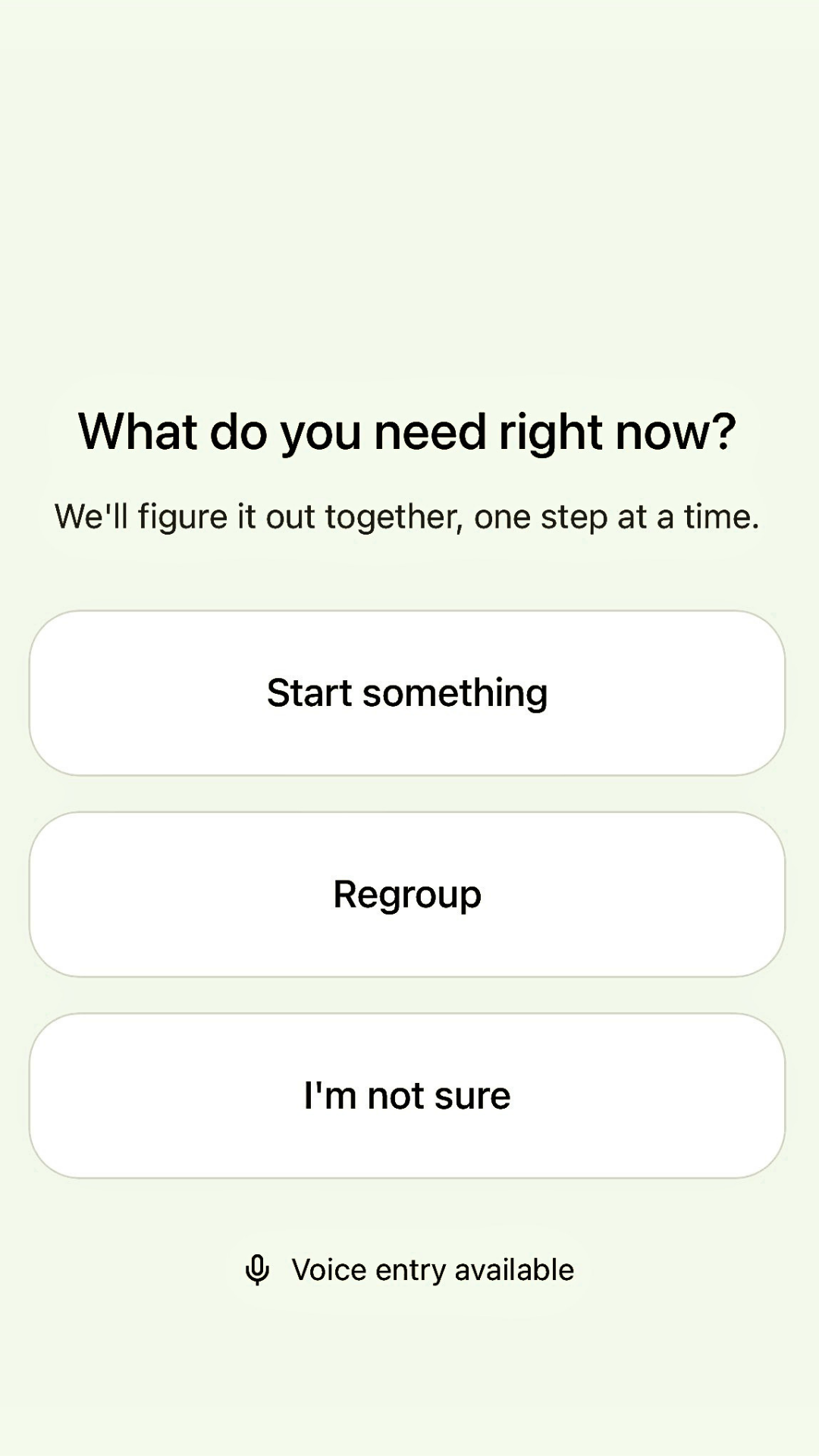
Entry point for reducing activation energy and clarifying next action.
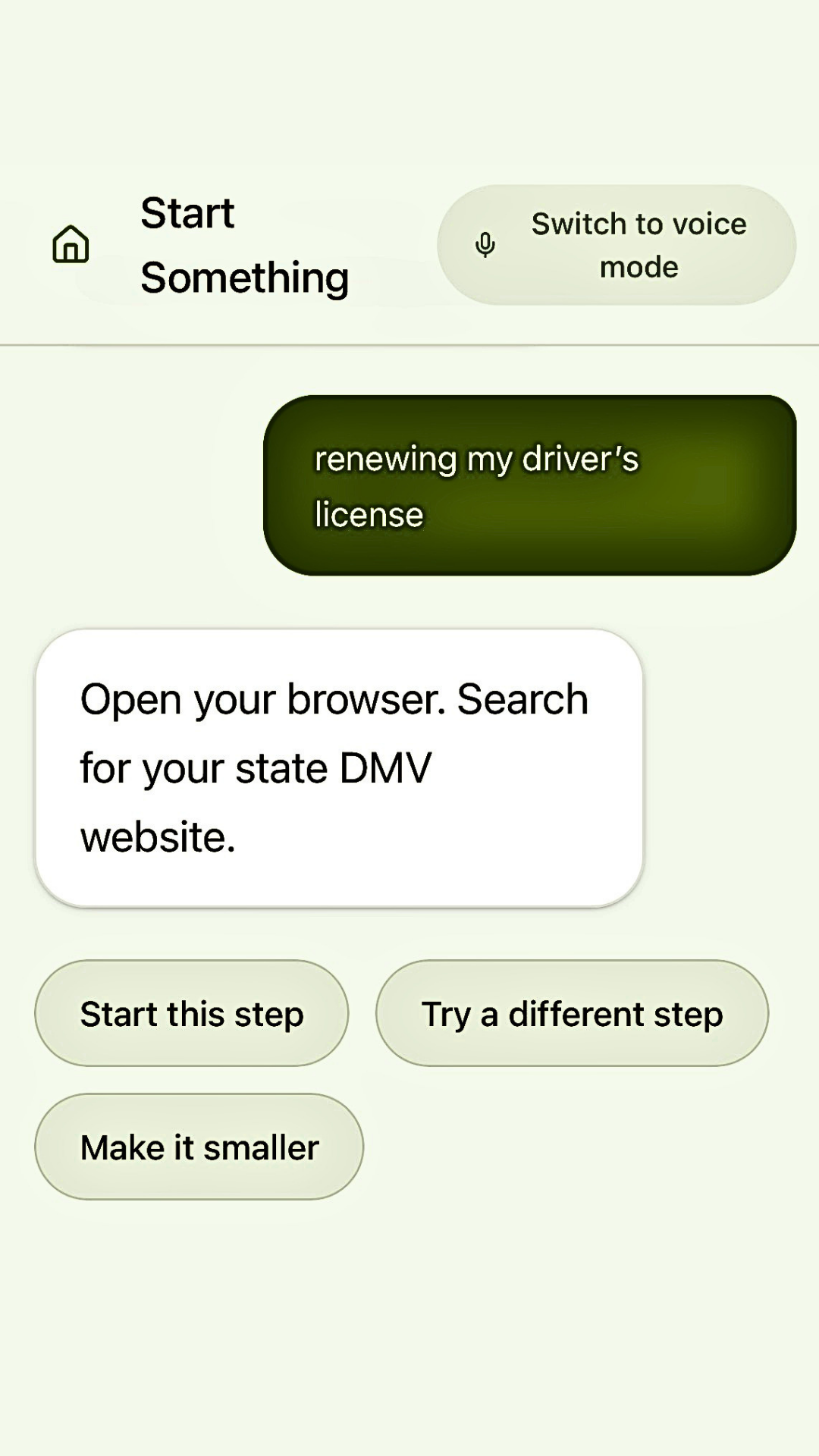
A concrete example of turning an overwhelming task into a first actionable step.
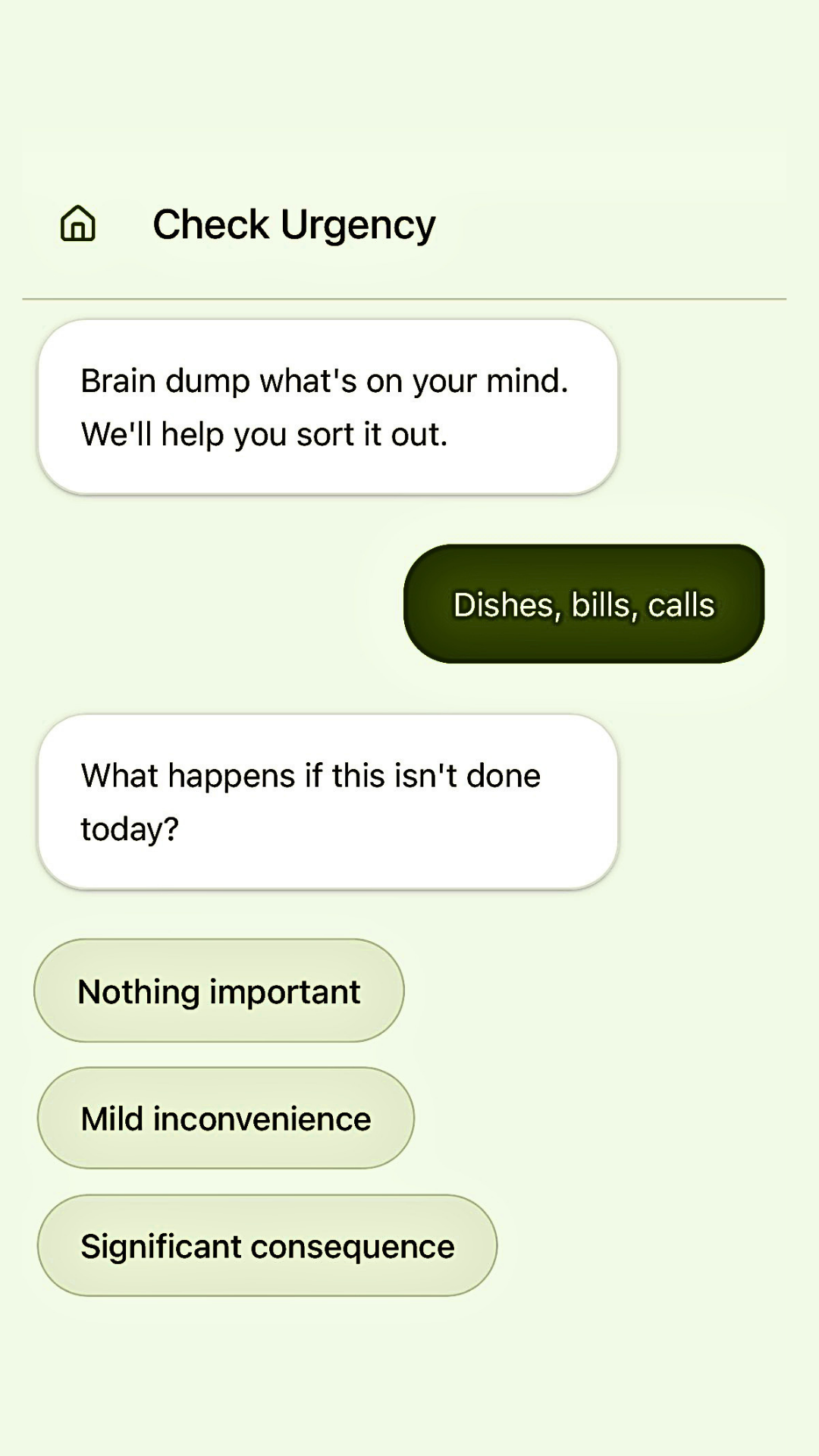
Helps users assess real urgency instead of reacting to internal pressure alone.
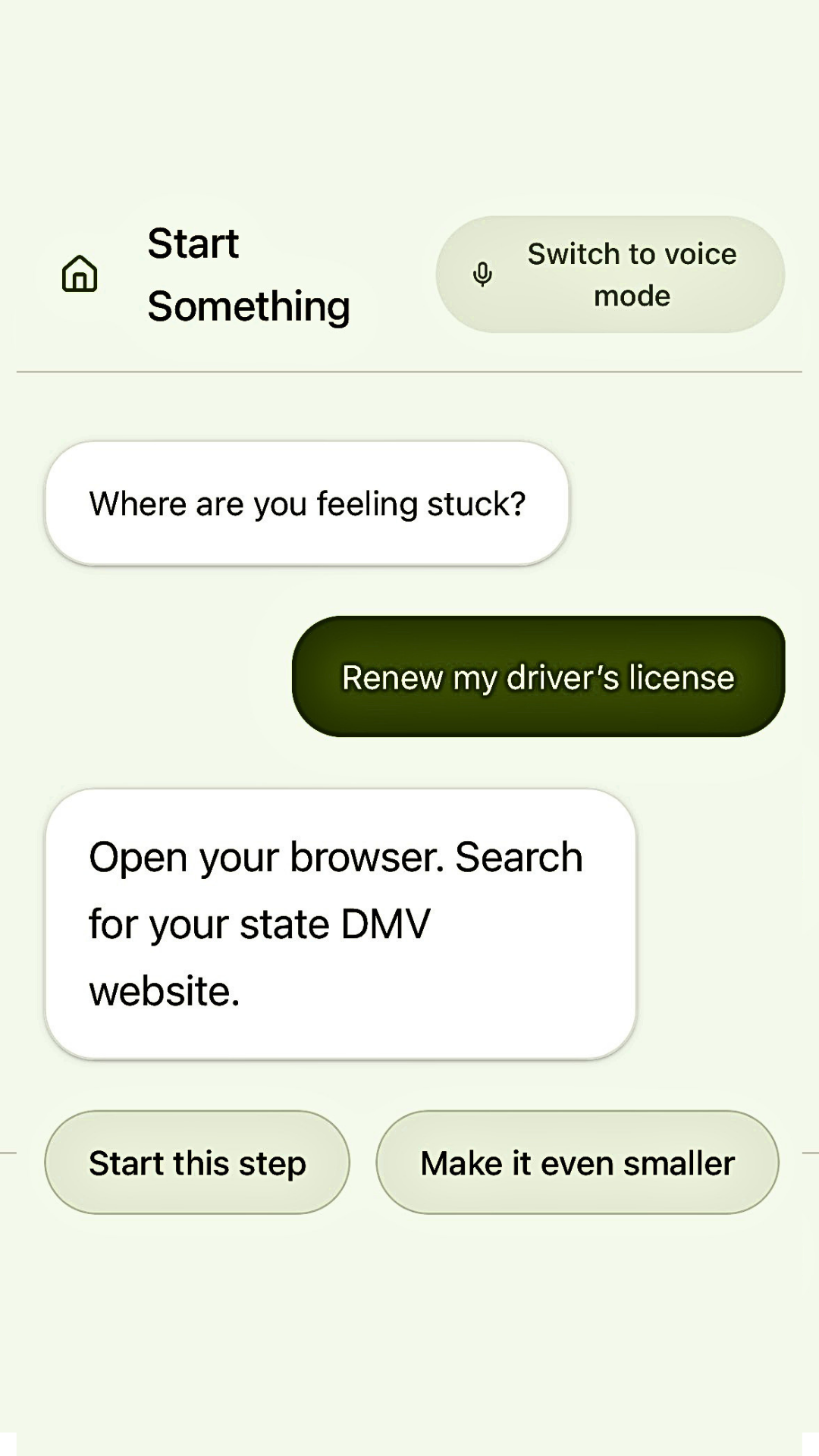
Breaks a task into a smaller, more psychologically reachable unit.
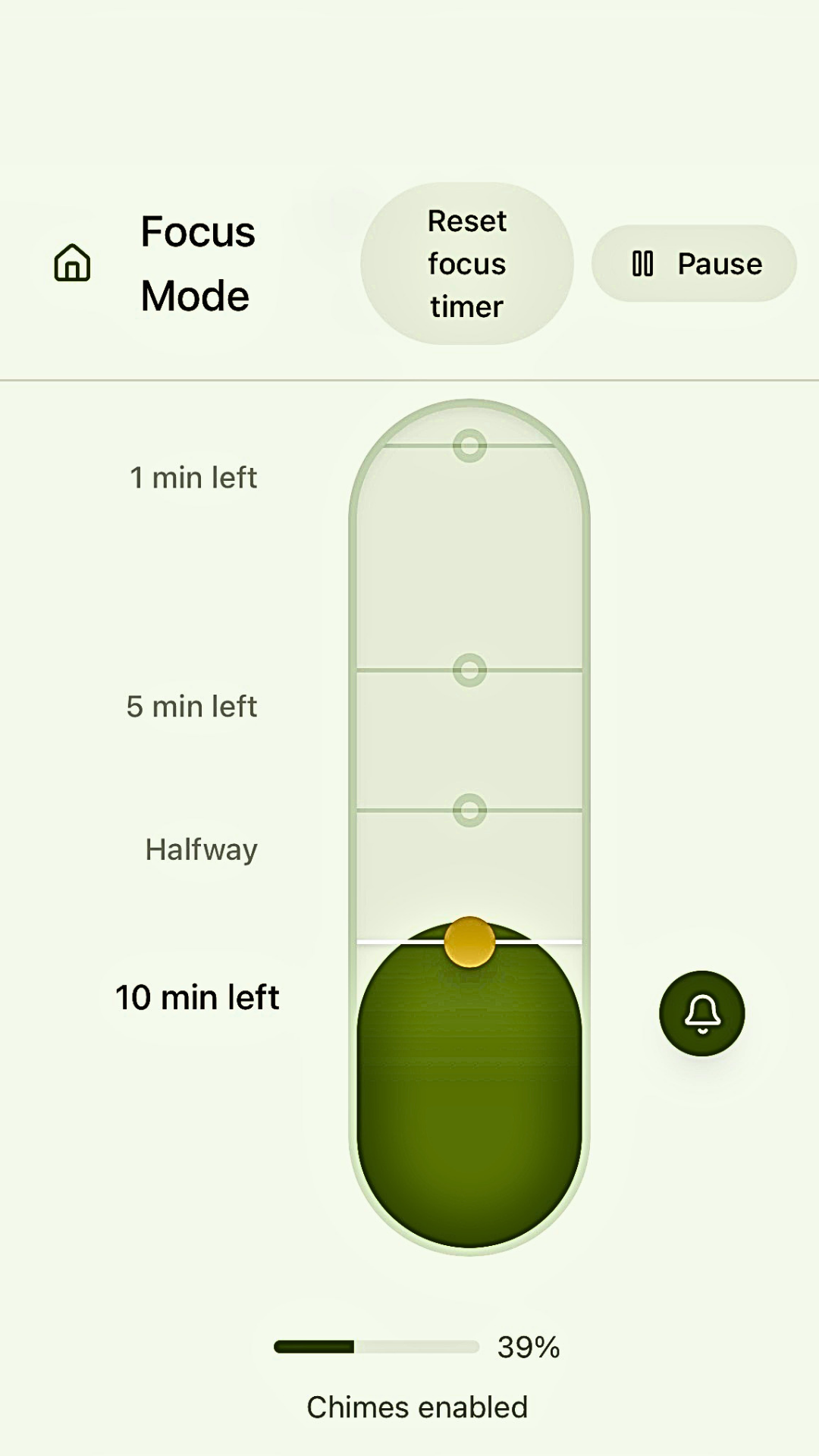
Creates a bounded, finite container for attention during initiation.
Transition chimes provide gentle sensory cues at the beginning and end of a focus interval, supporting users who benefit from externalized transitions and reduced reliance on internal time tracking.

A brief celebratory transition reinforces progress and gives closure to the task.
Scaffold is designed as a support system, not a productivity optimizer or autonomous agent. Its behavior is intentionally constrained to preserve user autonomy, minimize unintended influence, and reduce cognitive burden.
These constraints prioritize clarity, consent, and reversibility over automation and optimization.
See how the system supports users from overwhelm to action in a high-fidelity flow.
Open Interactive Prototype →If developed beyond prototype stage, Scaffold would require additional participatory research with neurodivergent users, stronger accessibility testing, privacy review, occupational therapy consultation, and careful evaluation of how AI support behaves under stress conditions.
The next product questions would be: When does support become pressure? What forms of memory feel helpful rather than invasive? How can the system stay useful while remaining transparent, optional, and easy to refuse?
“The project evolved from asking how systems can make people more productive to asking how systems can reduce the cognitive friction between intention and action.”
Scaffold reframes executive dysfunction as a mismatch between human cognition and system expectations—not as a failure of motivation.
The design challenge is not to push users harder. It is to reduce friction, preserve agency, and make action possible when internal resources are already strained.